Anthropic now runs four distinct Claude certifications, and the names alone don't make it obvious which one is actually for you. "Associate" sounds junior, "Architect" sounds senior, and "Developer" sits somewhere in between — but the real differences are about what role you're in, not how experienced you are.
I've gone through this landscape in detail while building free prep content for all four on this site. Here's the honest breakdown: what each certification actually tests, the hard numbers (cost, duration, passing score), and which one matches your actual job — not just your job title.
The Four Certifications at a Glance
| Certification |
Code |
Duration |
Questions |
Pass Score |
Cost |
Who It's For |
| Associate — Foundations |
CCAF |
90 min |
50 (MCQ) |
700/1000 |
$100 |
Business users, analysts, team leads using Claude day-to-day |
| Developer — Foundations |
CCDV-F |
120 min |
53 |
720/1000 |
$125 |
Software developers building with the Claude API/SDK |
| Architect — Foundations |
CCAR-F |
120 min |
60 (MCQ) |
720/1000 |
$125 |
Engineers designing agentic systems with Claude |
| Architect — Professional |
CCAR-P |
120 min |
60 (scenario-based) |
720/1000 |
$125 |
Architects already CCAR-F-certified, operating at enterprise scale |
All four: 12-month validity, delivered online or at a Pearson VUE test center. No certification requires a prior one except Professional, which assumes Foundations-level knowledge.
If you only remember one distinction: Associate is "can you use Claude well," Developer is "can you build with Claude," and the two Architect levels are "can you design systems with Claude" (Foundations) and "can you design systems with Claude at enterprise scale, with real tradeoffs" (Professional).
Claude Certified Associate — Foundations (CCAF)
Download the full-size infographic
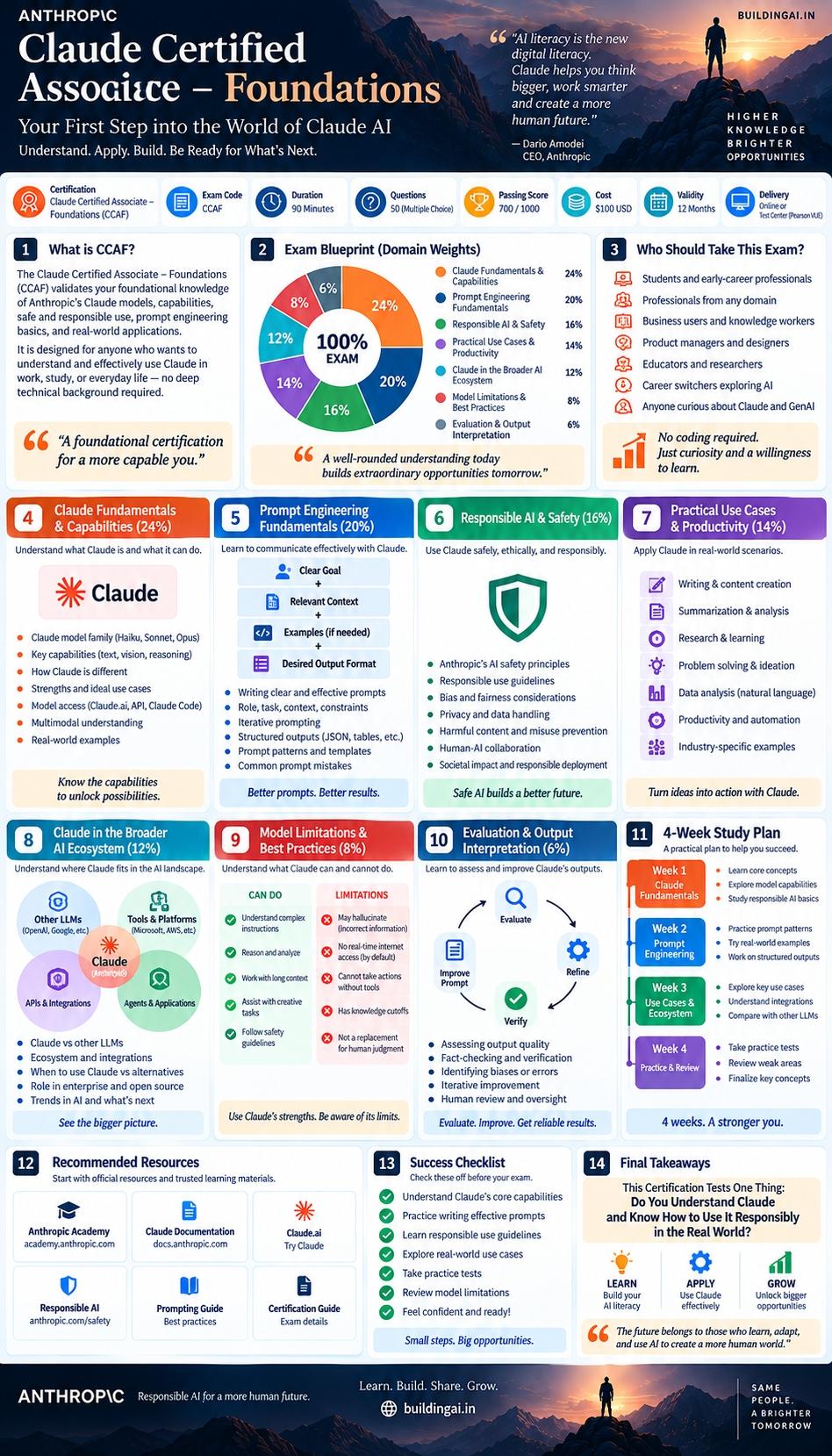
Who it's for: students, early-career professionals, business users, product managers, educators — anyone who wants to use Claude well in a business setting, no coding required.
What it tests (domain weights):
- Claude Fundamentals & Capabilities — 24%
- Prompt Engineering Fundamentals — 20%
- Responsible AI & Safety — 16%
- Practical Use Cases & Productivity — 14%
- Claude in the Broader AI Ecosystem — 12%
- Model Limitations & Best Practices — 8%
- Evaluation & Output Interpretation — 6%
This is the only one of the four with no coding, no API, no SDK on the exam. If your job is writing prompts, checking Claude's output before you act on it, or deciding which Claude product fits a task — this is your certification.
Free prep on this site: Course overview · practice quiz
Claude Certified Developer — Foundations (CCDV-F)
Download the full-size infographic
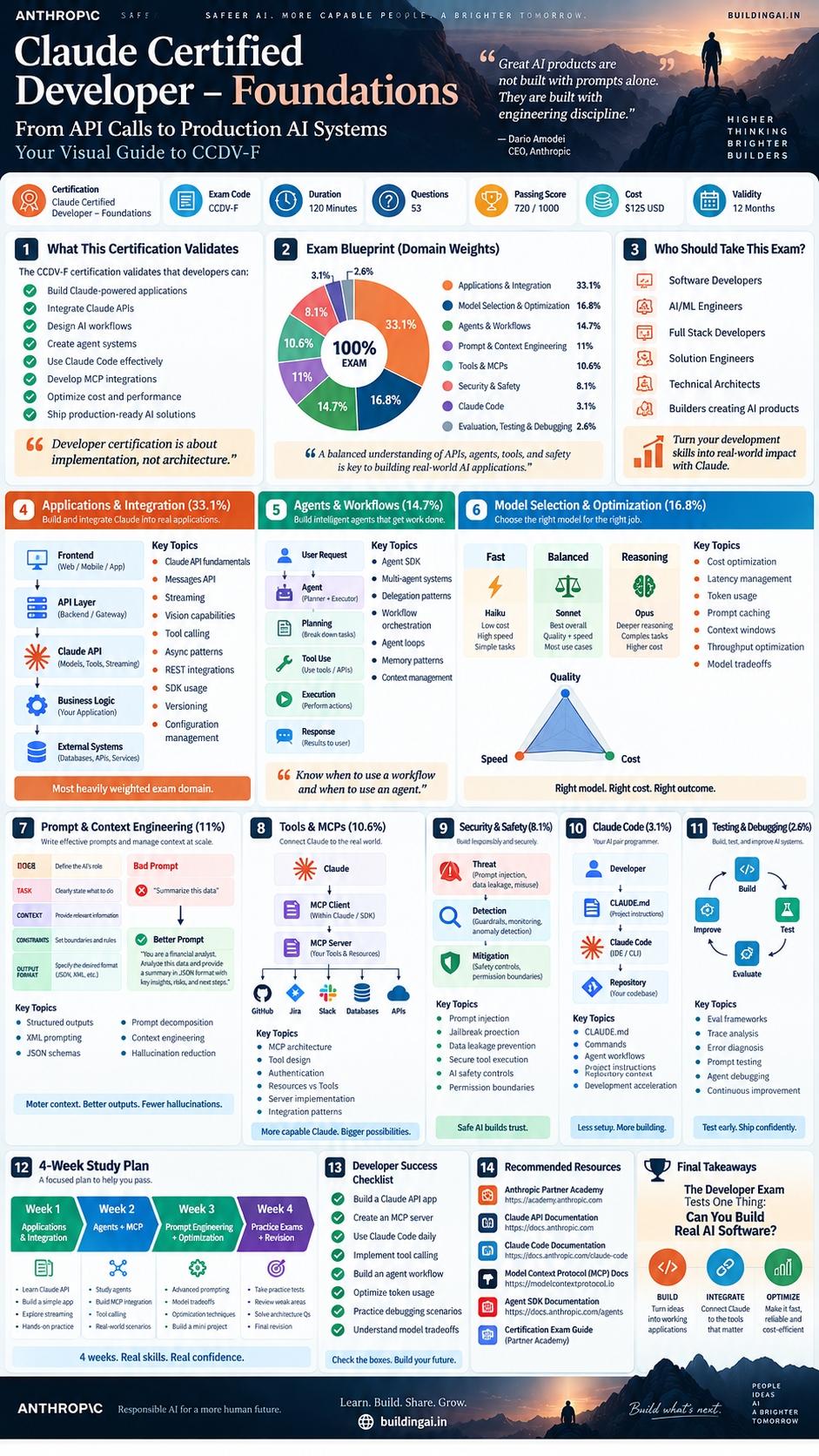
Who it's for: software developers, AI/ML engineers, full-stack and solution engineers — anyone shipping real Claude-powered applications.
What it tests (domain weights):
- Applications & Integration — 33.1%
- Model Selection & Optimization — 16.8%
- Agents & Workflows — 14.7%
- Prompt & Context Engineering — 11%
- Tools & MCPs — 10.6%
- Security & Safety — 8.1%
- Claude Code — 3.1%
- Evaluation, Testing & Debugging — 2.6%
A third of this exam is just "Applications & Integration" — building and integrating Claude into real apps (API calls, streaming, tool calling, SDK usage). This is a practitioner exam: it tests implementation, not architecture. "Developer certification is about implementation, not architecture" is the line worth remembering if you're deciding between this and Architect Foundations.
Free prep on this site: Course overview · practice quiz
Claude Certified Architect — Foundations (CCAR-F)
Download the full-size infographic
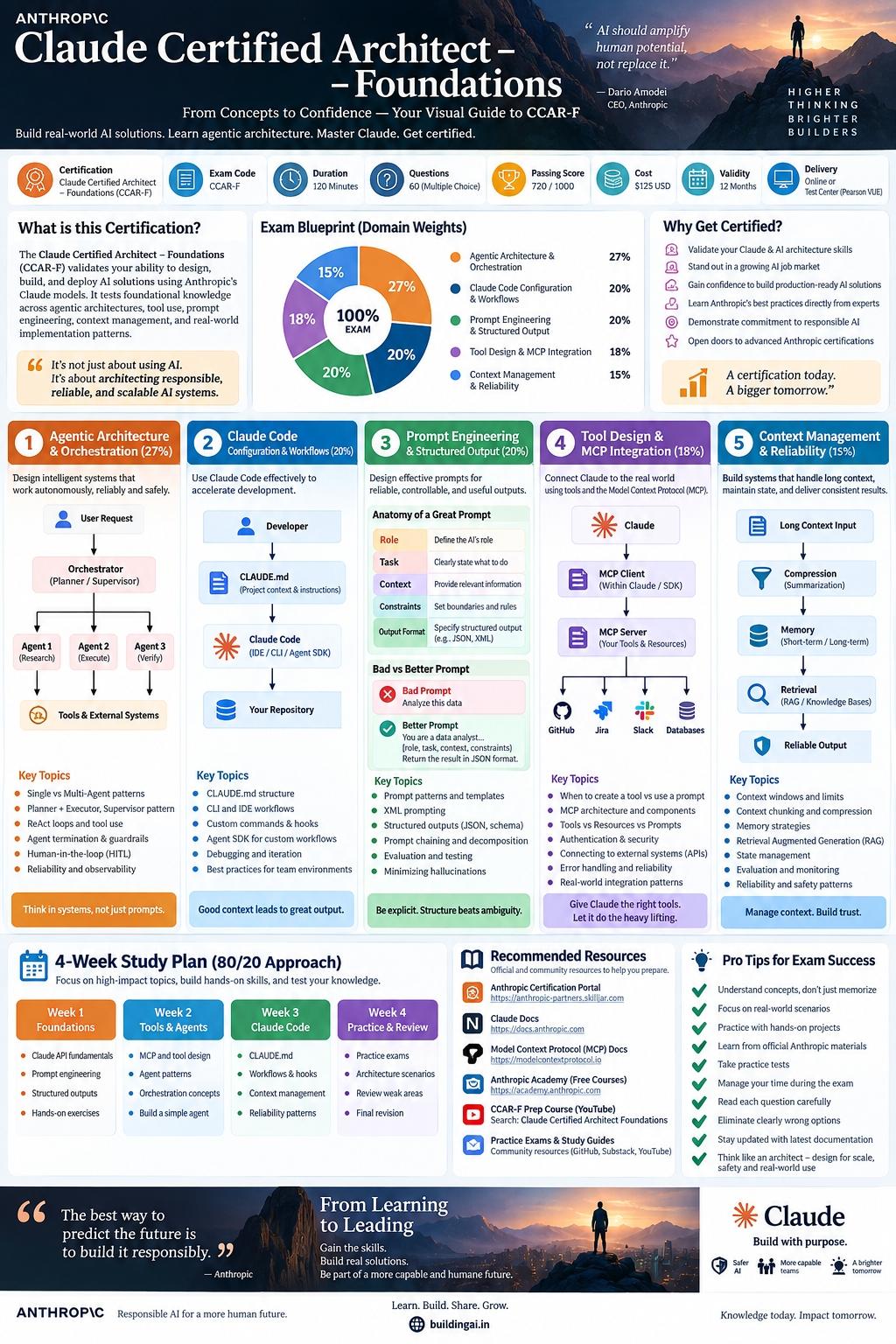
Who it's for: solutions architects, technical leads, engineers moving from "using Claude" to "designing systems with Claude" — the architecture-and-tradeoffs layer above Developer.
What it tests (domain weights):
- Agentic Architecture & Orchestration — 27%
- Claude Code Configuration & Workflows — 20%
- Prompt Engineering & Structured Output — 20%
- Tool Design & MCP Integration — 18%
- Context Management & Reliability — 15%
This is where the exam stops asking "can you call the API" and starts asking "can you design the agent, choose single- vs multi-agent, and make it reliable." If you've been building toward architecture-level decisions rather than feature-level implementation, this is the one.
Free prep on this site: 8-page complete course · practice quiz & mock exam · my personal pass experience
Claude Certified Architect — Professional (CCAR-P)
Download the full-size infographic
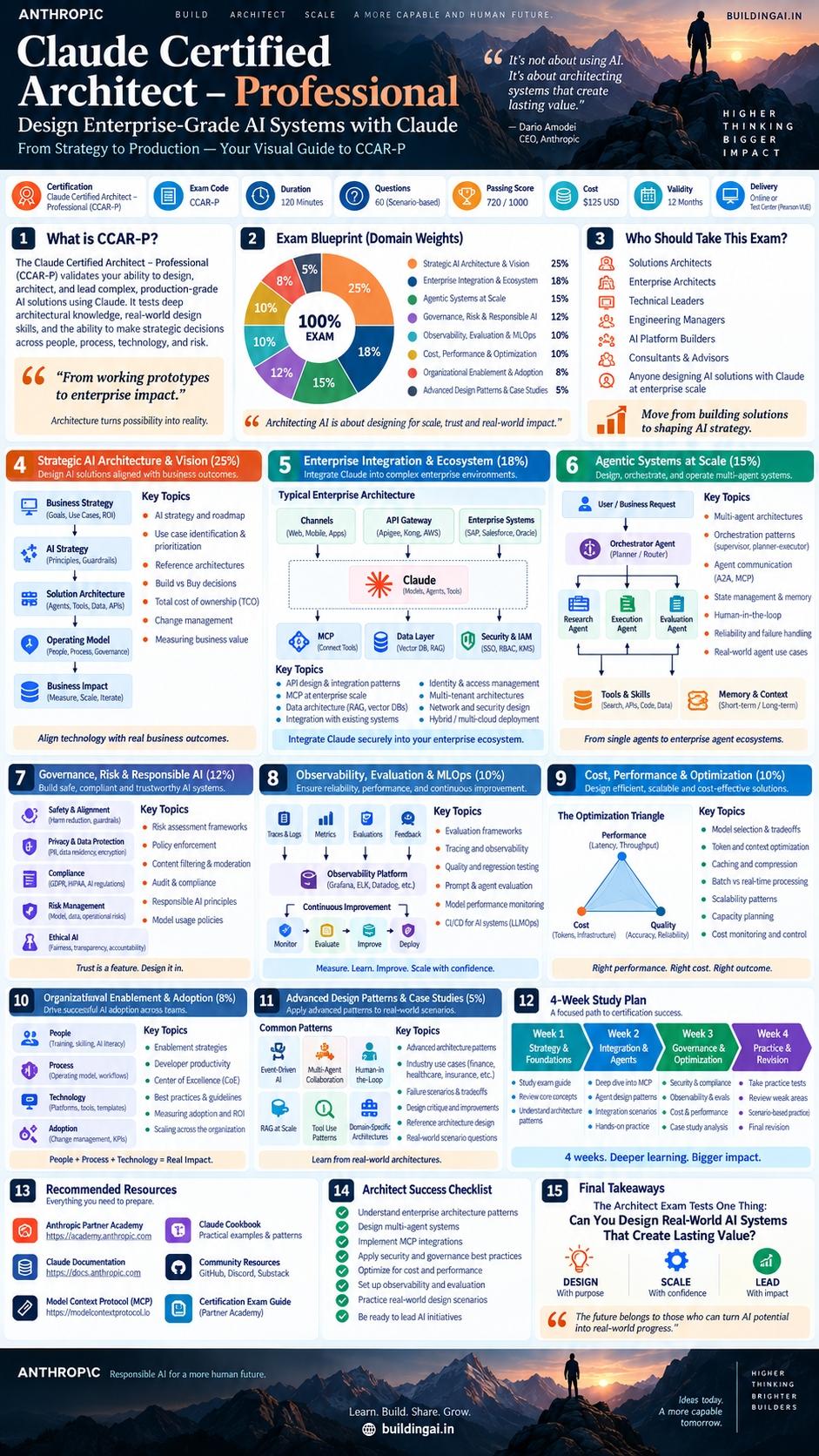
Who it's for: solutions architects, enterprise architects, technical leaders, AI platform builders — people already comfortable at the Foundations level who need to prove they can operate at enterprise scale.
What it tests (domain weights):
- Strategic AI Architecture & Vision — 25%
- Enterprise Integration & Ecosystem — 18%
- Agentic Systems at Scale — 15%
- Governance, Risk & Responsible AI — 12%
- Observability, Evaluation & MLOps — 10%
- Cost, Performance & Optimization — 10%
- Organizational Enablement & Adoption — 8%
- Advanced Design Patterns & Case Studies — 5%
The jump from Foundations to Professional is the jump from "design one agentic system" to "architect AI strategy, governance, and cost tradeoffs across an organization." All 60 questions are scenario-based — there's no pure recall here, it's judgment under constraints. "From working prototypes to enterprise impact" is the honest summary.
Free prep on this site: Course overview · practice quiz
So Which One Should You Take?
A few decision rules that cut through most of the overthinking:
- You use Claude but don't write code against it → Associate. Full stop, nothing else applies.
- You write application code that calls Claude, but you're not the one deciding the agent architecture → Developer.
- You're the one deciding single- vs multi-agent, tool design, and reliability patterns → Architect Foundations.
- You're already Architect-Foundations-level and your decisions now touch cost, governance, and multiple teams → Architect Professional.
They're not a strict ladder you have to climb in order — Associate and Developer test genuinely different skills (business use vs. implementation), not the same skill at different depths. Pick based on your actual role, not based on which title sounds more senior.
How to Actually Prepare
Every one of these exams rewards the same study shape, regardless of which you're taking: a 4-week plan that front-loads the heaviest-weighted domains, practice questions that force you to apply a concept rather than recall it, and a final week of nothing but timed practice exams.
All four free courses and practice quizzes linked above are built exactly that way — domain-weighted, with the highest-value material first. Start with whichever certification matches your current role from the decision rules above, or browse all four prep tracks on the certifications hub.