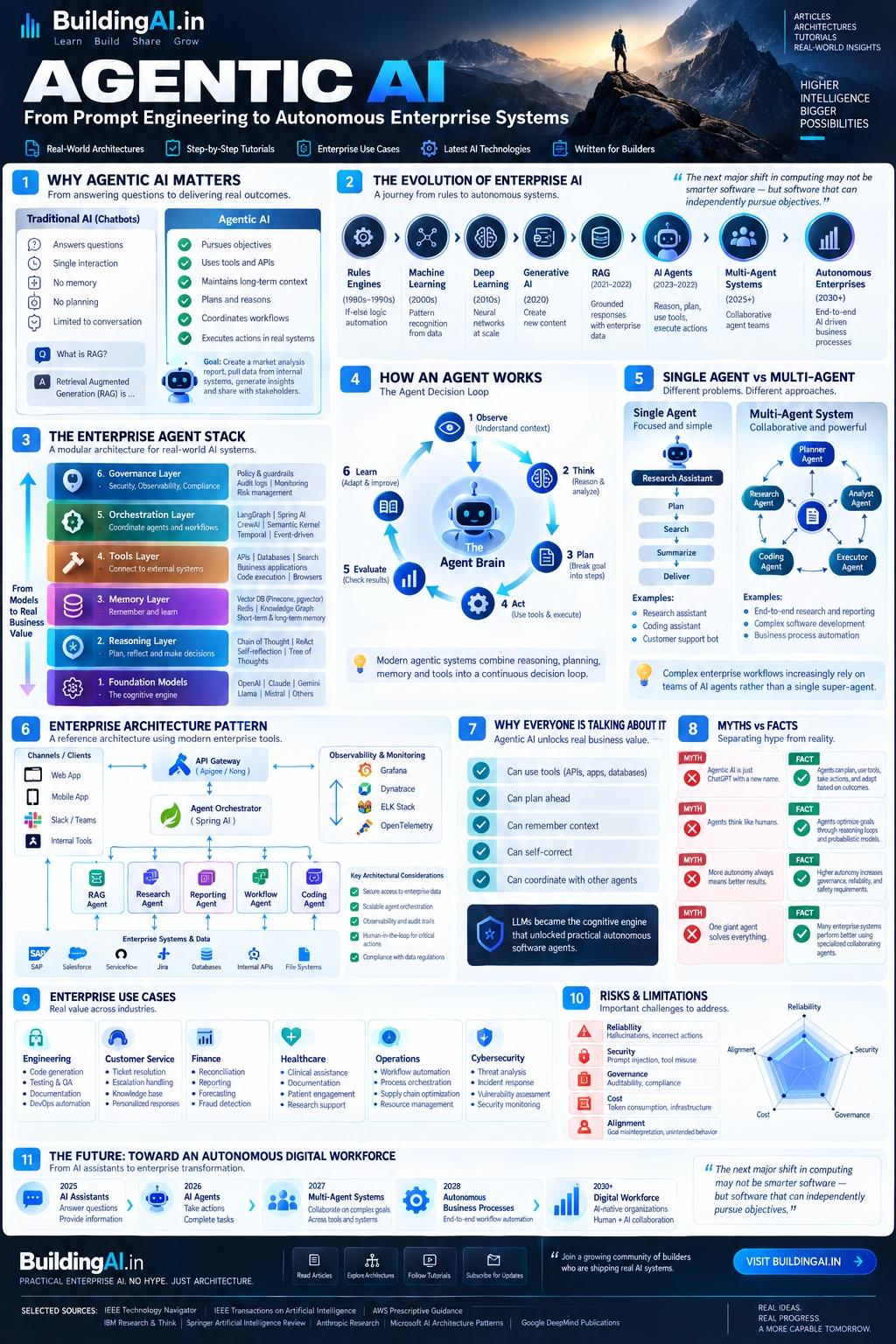
Download the full-size infographic
"Agentic AI" has become one of those terms everyone uses and almost nobody defines precisely. Is it just a chatbot with more steps? Is it the same thing as "AI agents"? Is it hype, or is there a real architectural shift underneath it?
There is a real shift — but it's easier to see once you stop treating "agentic AI" as a product category and start treating it as a capability upgrade on top of the LLM you already know. This post walks through what actually changes, how the pieces fit together, and where the real risks are — not the ones in the headlines.
Why Agentic AI Matters
A chatbot and an agent are built from the same underlying model. The difference is what happens around it.
|
Traditional AI (Chatbot) |
Agentic AI |
| Interaction |
Answers questions |
Pursues objectives |
| Scope |
Single turn |
Uses tools and APIs |
| Memory |
None |
Maintains long-term context |
| Capability |
Conversation only |
Plans and reasons |
| Workflow |
Limited to the chat |
Coordinates multi-step workflows |
| Output |
Text |
Executes actions in real systems |
Ask a chatbot "what is RAG?" and it answers from what it already knows. Give an agent the goal "create a market analysis report," and it has to decide what to pull from internal systems, which tools to call, how to sequence the work, and how to verify the result before handing it back — all without a human writing out each step.
That gap — from answering to doing — is the entire story of agentic AI.
The Evolution of Enterprise AI
Agentic AI didn't appear from nowhere. It's the next step in a fairly linear progression:
- Rules engines (1980s–90s) — if/else logic automation. Deterministic, brittle, but predictable.
- Machine learning (2000s) — pattern recognition from data. Still narrow, still single-purpose.
- Deep learning (2010s) — neural networks at scale. Better pattern recognition, still no reasoning.
- Generative AI (2020) — models that create new content instead of just classifying it.
- RAG (2021–2022) — grounding generation in retrieved enterprise data instead of parametric memory alone.
- AI agents (2023–2024) — models that reason, plan, use tools, and execute actions, not just generate text.
- Multi-agent systems (2025+) — collaborative agent teams, each with a narrower role, coordinating on a shared goal.
- Autonomous enterprises (2030+) — end-to-end AI-driven business processes, the horizon this is heading toward.
The useful takeaway isn't the dates — it's that each step solved a specific limitation of the one before it. Agents exist because RAG alone couldn't act, only answer with better information.
How an Agent Actually Works: The Decision Loop
Strip away the marketing and every agent runs the same loop:
- Observe — understand the current context (the request, the state of the system, prior steps).
- Think — reason about what the observation means and what's needed.
- Plan — break the goal into concrete steps.
- Act — execute a step, usually by calling a tool or API.
- Evaluate — check whether the result actually moved toward the goal.
- Learn — adapt the plan based on what the last step revealed.
Then it loops back to Observe with updated context. This is the mechanism underneath every "agentic" product you've seen — the loop is the product, everything else is tooling around it.
The reason this matters architecturally: each stage is a place a request can go wrong (a bad observation, a flawed plan, a misfired tool call), and each stage is something you need to be able to inspect, log, and evaluate independently if you're going to run this in production. "The agent didn't work" is not a debuggable bug report; "the plan step picked the wrong tool for this input" is.
Single Agent vs. Multi-Agent Systems
Not every problem needs a team of agents, and reaching for multi-agent by default is one of the most common over-engineering mistakes right now.
Single agent — focused and simple. One agent with a defined toolset (a research assistant, a coding assistant, a customer-support bot). Easier to debug, easier to reason about, cheaper to run. Good for well-scoped tasks with a clear success criterion.
Multi-agent system — collaborative and powerful. A planner/orchestrator agent delegates to specialized agents (research, analysis, coding, execution), each with its own tools and context. This is where complex, multi-domain workflows live: end-to-end research-and-reporting, full software development pipelines, cross-system business-process automation.
The decision rule I actually use: if a single well-prompted agent with the right tools can hit the success criterion, use one agent. Multi-agent earns its complexity when the task genuinely decomposes into specialist roles that benefit from separate context windows and separate tool access — not because "multi-agent" sounds more sophisticated in a design doc.
The Enterprise Agent Stack
From the model up to governance, a production agentic system is a layered stack, not a single call to an LLM:
- Foundation models — the cognitive engine (Claude, GPT, Gemini, Llama, and others).
- Reasoning layer — plan, reflect, and make decisions (chain-of-thought, self-reflection, tree-of-thought style techniques).
- Memory layer — remember and learn (vector DBs like Pinecone/pgvector, knowledge graphs, short- and long-term memory).
- Tools layer — connect to external systems (APIs, databases, search, business applications, code execution, browsers).
- Orchestration layer — coordinate agents and workflows (LangGraph, Spring AI, CrewAI, Semantic Kernel, Temporal).
- Governance layer — security, observability, compliance (policy guardrails, audit logs, monitoring, risk management).
Most teams I've seen struggle with agentic AI in production aren't struggling with the model — they're missing layers 4 through 6. A great reasoning loop on top of ungoverned tool access is how you get an agent that confidently does the wrong thing at scale.
A Reference Enterprise Architecture
A realistic enterprise pattern looks roughly like this:
Channels/Clients (Web, Mobile, Slack/Teams, Internal Tools)
        ↓
API Gateway (Apigee / Kong)
        ↓
Agent Orchestrator (Spring AI, or equivalent)
        ↓
┌─────────────┬─────────────┬──────────────┬─────────────┬────────────┐
│  RAG Agent  │Research Agent│Reporting Agent│Workflow Agent│Coding Agent│
└─────────────┴─────────────┴──────────────┴─────────────┴────────────┘
        ↓
Enterprise Systems & Data (SAP, Salesforce, ServiceNow, Jira, Databases, Internal APIs, File Systems)
Running alongside all of it: an observability and monitoring layer (Grafana, Dynatrace, the ELK stack, OpenTelemetry) watching every hop. If you can't trace which agent called which tool with what input, you can't debug a bad outcome and you can't prove compliance when someone asks how a decision was made.
Key architectural considerations that show up in every real deployment: secure access to enterprise data, scalable agent orchestration, observability and audit trails, human-in-the-loop for critical actions, and compliance with data regulations. None of these are optional extras — they're the difference between a demo and something you can actually run.
Myths vs. Facts
A few claims worth correcting, because they shape bad architecture decisions:
- Myth: "Agentic AI is just ChatGPT with a new name." Fact: agents can plan, use tools, take actions, and adapt based on outcomes — a fundamentally different capability surface, not a rebrand.
- Myth: "Agents think like humans." Fact: agents optimize goals through reasoning loops and probabilistic models — useful, but not human cognition, and it fails in different ways than human error does.
- Myth: "More autonomy always means better results." Fact: higher autonomy increases the need for governance, reliability engineering, and safety controls — autonomy is a cost you take on, not a free upgrade.
- Myth: "One giant agent solves everything." Fact: most production enterprise systems perform better with multiple specialized, collaborating agents than one agent trying to do everything.
Enterprise Use Cases
Where this is actually delivering value right now, not in a hypothetical future:
- Engineering — code generation, testing & QA, documentation, DevOps automation.
- Customer service — ticket resolution, escalation handling, knowledge-base search, personalized responses.
- Finance — reconciliation, reporting, forecasting, fraud detection.
- Healthcare — clinical assistance, documentation, patient engagement, research support.
- Operations — workflow automation, process orchestration, supply chain optimization, resource management.
- Cybersecurity — threat analysis, incident response, vulnerability assessment, security monitoring.
The common thread across all six: narrow, well-bounded tasks with a verifiable output, not "run the business." That's not a limitation of the technology so much as the correct scope for where agentic AI is actually reliable today.
Risks & Limitations
The infographic's risk radar maps to five axes worth tracking explicitly in any production deployment:
- Reliability — hallucinations, incorrect actions. The agent can be confidently wrong, and "confidently" is exactly the problem — it doesn't hedge the way a human unsure of an answer would.
- Security — prompt injection, tool misuse. Any tool-using agent is an attack surface; untrusted input reaching a tool call is a real exploit path, not a theoretical one.
- Governance — auditability, compliance. If you can't reconstruct why an agent took an action, you can't pass an audit or a post-incident review.
- Cost — token consumption, infrastructure. Multi-step reasoning loops and multi-agent coordination multiply token spend fast; this needs budgeting, not just monitoring after the bill arrives.
- Alignment — goal misinterpretation, unintended behavior. The agent optimizes for what you specified, not what you meant — and those two things diverge more than people expect.
None of these are reasons to avoid agentic AI. They're the engineering work that turns a demo into something you can run unattended.
The Future: Toward an Autonomous Digital Workforce
A reasonable read of where this is heading:
- 2025 — AI assistants: answer questions, provide information.
- 2026 — AI agents: take actions, complete tasks.
- 2027 — Multi-agent systems: collaborate on complex goals across systems.
- 2028 — Autonomous business processes: end-to-end workflow automation.
- 2030+ — Digital workforce: AI-native organizations with human + AI collaboration as the default operating model, not the exception.
The through-line: the next major shift in computing may not be smarter software, but software that can independently pursue objectives. That's a genuine architectural shift, which is exactly why it deserves the same rigor — governance, observability, cost discipline — that any other system handling real business processes gets.
If you want the implementation-level detail — orchestration patterns, observability setup, and the production architecture for running agents at scale — that's covered in Building Enterprise AI Agents.